

Last Updated: Nov 7, 2026 | Reading Time: 10 minutes | Author: Samantha Stupak | Reviewed by Dr. Wendy Ormsby, Doctor of Chiropractic
Disclaimer: This article is for informational purposes only and does not constitute veterinary advice. Always consult your licensed veterinarian before changing your pet’s health care, diet, or supplement routine.
There’s a moment most dog parents only notice in hindsight.
The pup who used to launch onto the bed now waits by the edge for a boost, the leash-hearing door sprinter now ambles over at a Sunday-stroll pace, and the fetch fanatic who never wanted to quit drops the ball after two throws.
It’s easy to chalk all of this up to an aging dog settling into a mellower era, and it’s also worth asking whether some of that slowdown is dog pain hiding in plain sight.
Joint pain in dogs usually begins with dozens of small moments that are easy to miss, long before a limp ever appears.
Dogs hide pain remarkably well, and the early signs look a lot like everyday life. By the time a limp shows up, those dog joints have usually been working overtime for a while.
How Common Is Joint Pain in Dogs?
More common than most pet parents realize. Joint disease is estimated to affect around 20% of dogs over one year old, with estimates as high as 80% in dogs over eight. (1)
A 2024 study of dogs over eight seen at a university clinic found joint changes in 36% to 57% of the shoulders, elbows, hips and knees examined, depending on the joint. (2)
Puppies and young adults aren’t off the hook either.
In a study of 123 dogs between 8 months and 4 years old, nearly 40% already showed joint changes on X-rays, and only two dogs with sore joints received any comfort support at all. (3)
One of our favorite findings comes from a study where pet parents filled out a simple nine-question checklist before a routine checkup. Of 500 dogs whose people checked at least one box, 38% had joint disease nobody knew about. (4) That gap comes down to information, and dogs share very little of it on purpose. We’ve built our own version of that checklist at the end of this post.
Why Dogs Hide Pain So Well
For your dog’s wild ancestors, showing weakness could make them a target, and that instinct still lives on in the pup snoring on your couch.
Most dog pain shows up as workarounds, not yelps.
Dogs shift their weight, change how they sit, stand, and climb, and skip activities that hurt, all without making a sound. In one study, owners most often noticed these shifts during everyday movement, like standing up or hopping on and off the couch. (5)
When researchers interviewed owners of dogs later found to have joint disease, most described subtle, on-and-off changes in behavior and mood they hadn’t connected to their dog’s joints, and some waited many months before getting their dog checked. (6)
If that sounds familiar, you’re in very good company.
Where Bioenergetics Fits Into Joint Health in Dogs
At PetMedella, we look at joint health in dogs through the lens of whole-body bioenergetic health.
Every cell, tissue, and organ system in your pet’s body carries its own energetic frequency, and those frequencies can shift as the body works harder to stay in balance.
Our bioenergetic Full Scan for pets uses bioresonance to evaluate how your pet’s body responds energetically across 14 body systems, including the Locomotor System, which keeps your dog running, jumping, and zooming around the yard. It also looks at nutrients that may be low and toxins that may be resonating, two factors that can add to the load on hardworking joints.
Whether you’re curious about bioenergetics or simply want to tune in more closely at home, knowing what to look for is the first step.
8 Early Signs of Joint Pain in Dogs To Watch For
1. Morning stiffness that wears off during the day
Your dog gets up slowly, takes a few creaky first steps, then seems totally fine by breakfast.
It’s tempting to file this under “just waking up.” Slowness to rise, especially after a long rest, is one of the most commonly listed early signs of joint discomfort, and it often eases once your pup gets moving. (7)
It looks like a sleepy dog, which is exactly why it’s so easy to miss.
2. Lagging on walks
Your once-enthusiastic walking buddy now falls behind, takes sniff breaks that feel like stalling, tires out sooner, or starts steering you home before you’re ready.
Tiring easily or lagging on walks was one of the questions on that nine-item owner checklist (4), and owners of dogs with joint disease describe walks that gradually become slower and shorter. (8)
3. Hesitating before jumping, climbing stairs, or getting into the car
This is one of the clearest early signals.
A dog who used to leap now pauses, plants their front paws on the edge, looks back at you for a lift, or simply walks away. Trouble with stairs and limited jumping appear repeatedly in descriptions of early joint discomfort. (7)
In dog terms, your pup has run a quick cost-benefit analysis, and the couch just isn’t worth it today.
4. Personality shifts: grumpy, withdrawn, or just… different
This one surprises pet parents the most. A dog with ongoing joint discomfort may become:
- More irritable, especially when touched near a sore spot
- Less enthusiastic, slower to greet you at the door or ask for belly rubs
- More withdrawn from family time, other pets, or play
- Restless or unsettled when trying to lie down
Behavior experts estimate that around a third of dogs referred for behavior problems have a painful condition, and musculoskeletal discomfort is one of the most common culprits. (9)
Dog pain often shows up in behavior first.
As we’ve explored in our blog on Introduction to Homeopathy for Pets, behavioral changes in animals often have an easy-to-overlook physical root. A dog who grumbles when you pet their lower back may be showing you exactly where it hurts.
5. Restlessness or unusual sleeping positions
A dog with achy joints can’t always find a comfy spot. You might notice:
- Shifting positions often during naps
- Sleeping with legs stretched at unusual angles
- Extra pacing or circling before lying down
- Choosing a cool, firm floor over their usual plush bed
Each little quirk is your dog trying to solve a comfort problem.
6. Playing less, engaging less
Play is often the first thing to fade. Your pup drops the ball sooner, stops starting games of tug, and watches the zoomies from the sidelines at the dog park. Limited play sits alongside stiffness and stair trouble as a common early sign (7), and it can show up well before any visible limp.
As we’ve written about in our6 Best Supplements for Your Senior Dog blog, “changes in daily habits, along with physical signs, may indicate pain. The art of observation is key.”
7. Muscle loss along the limbs or spine
When a dog protects a sore joint over time, the surrounding muscles thin from reduced use. Run your hands along both sides of your dog’s body, over the thighs, shoulders, and lower back. Does one side feel noticeably slimmer than the other? Weight gain paired with muscle loss in the limbs and along the spine is a recognized early sign of joint wear. (10) By the time you can feel the difference, joint stress has usually been building for a while.
8. Indoor accidents or difficulty posturing
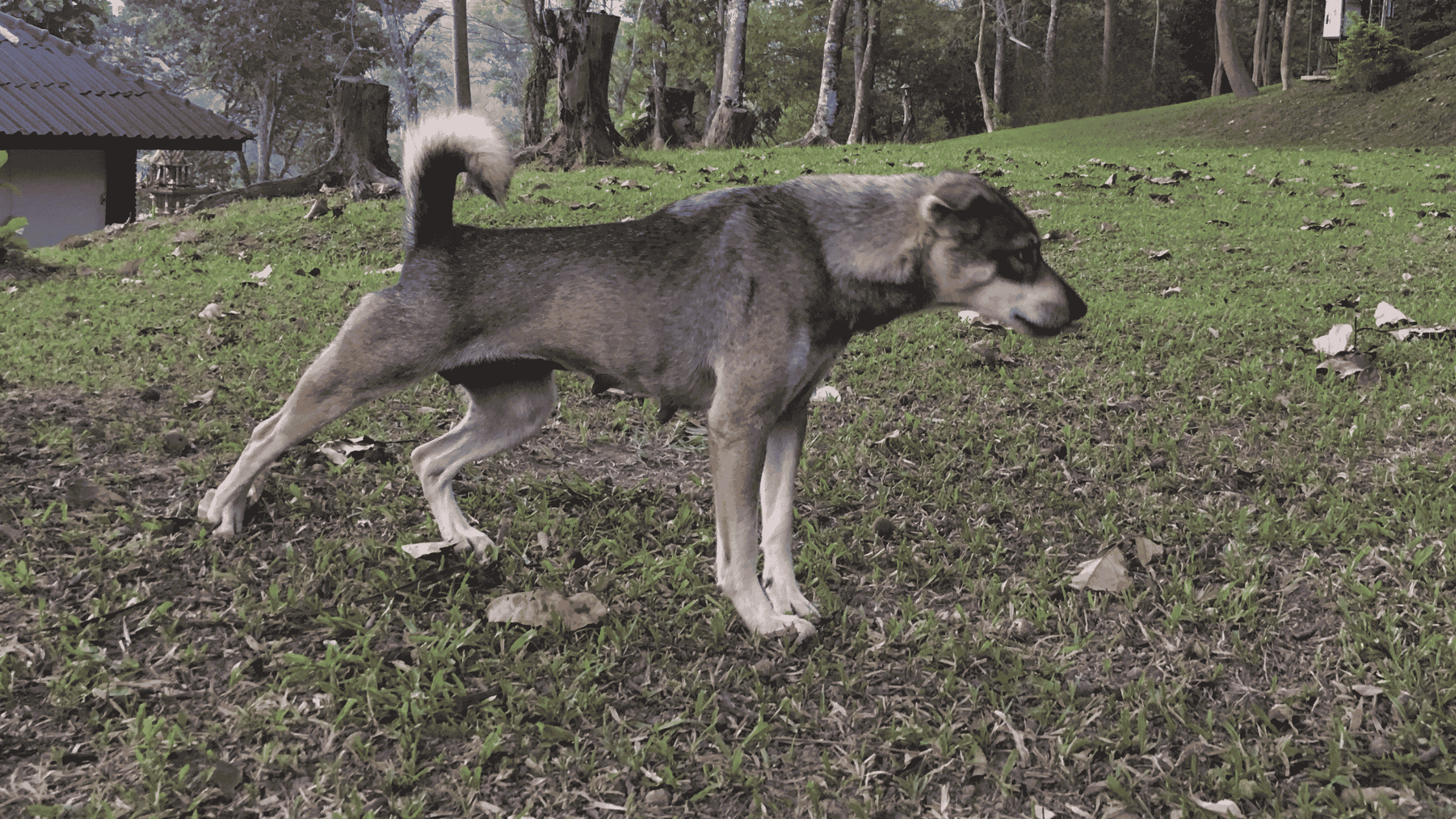
This one gets misread all the time. A house-trained dog who starts having accidents, or who seems uncomfortable squatting to pee or poop, may have sore joints that make getting into position painful.
House-soiling is one behavior change researchers link to underlying discomfort. (9) If bathroom habits change alongside any other sign on this list, that combination deserves a closer look.
Why Joint Pain in Dogs Shows up Long Before the Limp
A limp is what happens when your dog’s body runs out of workarounds. Before that point, your pup is busy doing all of this behind the scenes:
- Shifting weight away from the sore joint while standing and moving
- Skipping the things that hurt without being asked
- Changing how they sit, rise, and lie down to take pressure off sore spots
A practical guide from UC Davis describes how joint discomfort tends to progress over a dog’s life (11):
| Life stage | What it can look like |
|---|---|
| Puppies and young dogs | Brief, on-and-off signs lasting seconds to minutes, often written off as growing pains |
| Young adults | On-and-off stiffness lasting a few hours, often after a big burst of activity, that settles after a night’s rest |
| Middle age | Gradually less stamina for walks and play, the point where many dogs finally get noticed |
| Senior years | Steadily harder to walk comfortably |
The sweet spot for support is those first two stages, while the signals are still subtle.
Is Your Aging Dog at Higher Risk?
| Factor | What to Know |
|---|---|
| Age 8+ | Being over eight is a well-established risk factor, and odds keep climbing with age |
| Large breeds | Labrador and Golden Retrievers are among the breeds with higher odds of joint disease |
| Extra pounds | Higher body weight is linked to higher odds of joint disease and can make joint wear worse |
| Prior injury | Trauma substantially increases risk in the affected joint |
| Hip or elbow instability | Hip dysplasia and elbow subluxation are common early precursors |
Joint Pain Relief for Dogs, the Whole-Body Way
At PetMedella, we see joint health in dogs as a whole-body conversation. What shows up in the joints can be tied to inflammation, nutrient imbalances, toxin load, and energetic stress that began long before the first stiff morning.
If you’ve been searching for joint pain relief for dogs, a whole-body approach starts with understanding where that stress is coming from. Here’s what the Full Scan helps you explore:
- Locomotor System: how the system responsible for your dog’s movement is responding energetically
- Nutrients: which nutrients may be bioenergetically low, including the building blocks joints and connective tissue rely on
- Toxins and stressors: which environmental toxins may be bioenergetically resonating and adding to your pet’s overall load
- A customized balancing plan: remedies matched to your pet’s results so that you can skip the guesswork
Here are some of the remedies that may show up in your pet’s balancing regimen to support their joints:
🌿Pre & Post Milieu Physica
A homeopathic remedy for locomotor support, pain drainage, and healing. Contains Arnica Montana 200X, Hypericum Perforatum, Symphytum Officinale. It often appears in regimens for pups showing early signs of joint or connective tissue stress.
🌿 Jointox BB
Traditionally used to relieve joint and muscle aches and pains. Contains Rhus Tox 30C, Bryonia 30C, Ledum Palustre 30C, and Kalmia Latifolia 30C homeopathic remedies classically associated with joint and musculoskeletal discomfort, including joint stress connected to tick-borne concerns like Lyme.
🌿 Borage Intrinsic
Essential fatty acid and inflammation support from borage, flax, red clover, pau d’arco, and milk thistle in a BioPhotonic Signaling Matrix Base. Traditionally used for joint issues and whole-body inflammation.
🌿 Kelpcom
An herbal blend of kelp, Irish moss, sarsaparilla, watercress, and cayenne, traditionally used to support healthy weight and joint health. That two-for-one matters, since extra weight is one of the most changeable risk factors for sore joints.

Simple Ways To Support Dog Joints at Home
While you watch for signs, a few small changes can make daily life easier on your dog’s joints:
- Lay rugs or runners on slick floors so your pup can get traction
- Add a ramp or pet steps for the bed, couch, or car
- Keep walks shorter, steadier, and on easier ground, which is how many owners of dogs with joint disease naturally adapt
- Help your dog stay at a lean, healthy weight
- Offer a supportive, orthopedic-style bed in a warm, draft-free spot
Your At-Home Observation Checklist
Grab a pen and observe your dog for one week. Owner observations at home are key to assessing ongoing discomfort, so your notes matter.
- Stiff after sleeping, loosens up within minutes
- Hesitates before jumping, stairs, or the car
- Slows down or stops earlier on walks
- Less excited about greetings or play
- Grumbly when touched on the back, hips, or shoulders
- Restless when resting, can’t seem to get comfy
- One side feels slimmer than the other
- Indoor accidents or trouble squatting
- Weight gain paired with less activity
Even one is worth paying attention to. Early support before a limp ever develops is where holistic care makes its biggest difference.
The Bottom Line
Your dog’s version of “my hips hurt” may sound like a softer greeting, a slower morning, or a walk that wraps up a block early. That’s the conversation, and now you know how to hear it.
At PetMedella, we’re here to help you respond with tools that look at your pet’s whole body, joints included.
Start with a PetMedella Full Scan →
Go deeper into your pet’s results with one of our trained practitioners.
About the Author
Founder, CBH Energetics
Samantha has over 14 years of experience and more than 50,000 bioenergetic scans analyzed worldwide. Her work focuses on identifying patterns of imbalance across systems and helping clients and practitioners understand the deeper connections driving their health challenges. She sits on the board of the American Intervention Institute.
Areas of expertise: Bioenergetic testing · Hormone balancing · Detoxification · Nervous system regulation · Metabolic health · Lyme disease
References
- BreAnderson KL, O’Neill DG, Brodbelt DC, et al. Prevalence, duration and risk factors for appendicular osteoarthritis in a UK dog population under primary veterinary care. Scientific Reports, 2018. https://pmc.ncbi.nlm.nih.gov/articles/PMC5884849/
- Roitner M, Klever J, Reese S, Meyer-Lindenberg A. Prevalence of osteoarthritis in the shoulder, elbow, hip and stifle joints of dogs older than 8 years. The Veterinary Journal, 2024;305:106132. https://doi.org/10.1016/j.tvjl.2024.106132
- Enomoto M, de Castro N, Hash J, et al. Prevalence of radiographic appendicular osteoarthritis and associated clinical signs in young dogs. Scientific Reports, 2024;14:2827. https://pmc.ncbi.nlm.nih.gov/articles/PMC10838335/
- Wright A, Amodie D, et al. Identification of canine osteoarthritis using an owner-reported questionnaire and treatment monitoring using functional mobility tests. Journal of Small Animal Practice, 2022;63(8):609-618. https://pmc.ncbi.nlm.nih.gov/articles/PMC9543207/
- Demirtas A, Atilgan D, Saral B, et al. Dog owners’ recognition of pain-related behavioral changes in their dogs. Journal of Veterinary Behavior, 2023;62:39-46. https://www.sciencedirect.com/science/article/abs/pii/S1558787823000345?via%3Dihub
- Belshaw Z, Dean R, Asher L. Could it be osteoarthritis? How dog owners and veterinary surgeons describe identifying canine osteoarthritis in a general practice setting. Preventive Veterinary Medicine, 2020;185:105198. https://pmc.ncbi.nlm.nih.gov/articles/PMC7755036/
- Merck Veterinary Manual. Osteoarthritis in Dogs and Cats. https://www.merckvetmanual.com/musculoskeletal-system/osteoarthritis-in-dogs-and-cats/osteoarthritis-in-dogs-and-cats
- Belshaw Z, Dean R, Asher L. Slower, shorter, sadder: a qualitative study exploring how dog walks change when the canine participant develops osteoarthritis. BMC Veterinary Research, 2020. https://pmc.ncbi.nlm.nih.gov/articles/PMC7063782/
- Mills DS, Demontigny-Bédard I, Gruen M, et al. Pain and problem behavior in cats and dogs. Animals, 2020;10(2):318. https://doi.org/10.3390/ani10020318
- VCA Animal Hospitals. Five signs your pet has osteoarthritis. https://vcahospitals.com/resources/conditions/five-signs-your-pet-has-osteoarthritis
- UC Davis School of Veterinary Medicine. A practical approach to managing osteoarthritis. https://www.vetmed.ucdavis.edu/sites/g/files/dgvnsk491/files/inline-files/Medical-Management-OA-08228.docx
- American College of Veterinary Surgeons (ACVS). Osteoarthritis in dogs. https://acvs.org/?p=7142
DISCLAIMER: Creating Balanced Health, LLC/CBH Energetics and any parent, subsidiary, affiliated or related entities and companies do not provide medical advice or services. This post and bioenergetic products and services offered by Balanced Health, LLC/CBH Energetics including, but not limited to, bioenergetic tests, bioenergetic scans, bioenergetic reports and related products and services (collectively the “Bioenergetic Products and Services”) are designed for educational and informational purposes only and are not intended to diagnose, treat, cure, or prevent any disease, condition, complaint, illness or medical condition and are not a substitute for professional services or medical advice. Seek the advice of a physician or other qualified healthcare professional with any questions you may have. Never disregard professional medical advice or delay seeking treatment. These statements have not been evaluated by the Food and Drug Administration (FDA) or any other government agencies or regulatory authorities.</h6>